PrintableToolkit Notes
What is PrintableToolkit?
A practical introduction to PrintableToolkit: which printable World Cup tools to use, when to choose PDF, CSV, or calendar export, and how the site helps real planning.
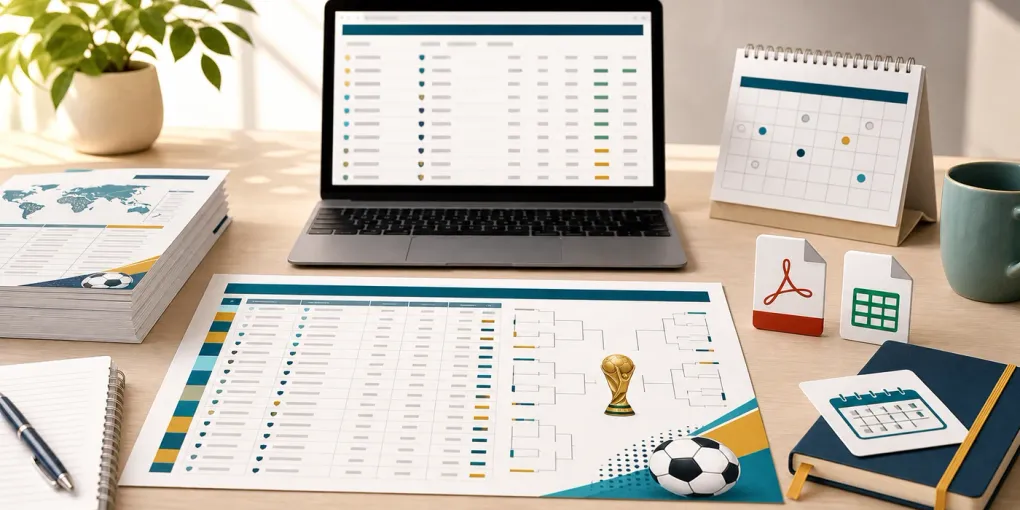
PrintableToolkit is a print-first planning site. It helps you turn busy schedules into clean pages you can use on paper, in a spreadsheet, or in a calendar app.
The first set of tools focuses on the 2026 World Cup because the tournament has a real planning problem: many matches, multiple time zones, group-stage tracking, knockout placeholders, TV planning, and people who still need a simple sheet on a wall. PrintableToolkit is designed for that moment when a normal fixture page is accurate but not useful enough for your actual day.
Start here if you are new
If you want one complete file, open the World Cup 2026 printable schedule PDF. It is the best starting point because it combines the full match list with time zone selection, team highlighting, stage filters, PDF output, CSV export, and calendar download.
If you are planning from California, Oregon, Washington, Nevada, British Columbia, or another West Coast location, use the Pacific Time schedule. It saves you from constantly converting Eastern Time or host-city time by hand.
If you care about who advances, use the printable bracket and the groups printable together. The groups page helps you track qualification; the bracket helps you follow the knockout path after teams advance.
If you are coordinating viewing plans, open the TV schedule. It is useful for shared screens, watch parties, offices, bars, school events, and family plans where the viewing location matters as much as the kickoff time.
Choose the right export
PrintableToolkit is built around three outputs because people plan in different ways.
Use PDF when the schedule needs to be printed, posted, emailed, or saved as a clean snapshot. This is the best format for walls, binders, classrooms, reception desks, shared noticeboards, and offline use.
Use CSV when the schedule needs to change. A spreadsheet is better for adding columns such as predicted score, actual score, watch location, owner, room, food plan, travel note, or priority.
Use ICS when the schedule needs reminders. Calendar files are best for the matches you do not want to miss, especially if you are filtering by one team or one stage.
The useful version is often a combination: PDF for the shared reference, CSV for planning edits, and ICS for personal alerts.
Example workflows
For a fan following one team:
- Open the schedule PDF.
- Choose your local time zone.
- Highlight your team.
- Export the filtered calendar file for reminders.
- Print a one-team sheet for the fridge, office, or match-day folder.
For a watch party:
- Open the TV schedule.
- Choose the time zone of the room where people will watch.
- Keep only the matches your group plans to show.
- Export CSV and add columns for screen, host, food, and setup time.
- Print the final version for people who will not check a calendar app.
For a prediction game:
- Print the groups page before the group stage.
- Use the bracket for knockout predictions.
- Keep the schedule PDF nearby for actual match times.
- Reprint after the group stage once advancement paths are clearer.
What makes this different from a normal schedule page
A normal schedule page is built for browsing. PrintableToolkit is built for doing.
That means the page should answer the next practical question: Should this be printed? Should it be filtered? Should it be edited? Should it become a reminder? Should it link to a bracket, group tracker, or TV plan?
The site also keeps internal paths close together. From any World Cup tool, you should be able to move to the next planning surface: schedule, Pacific Time, bracket, groups, TV, or the blog for notes and updates.
Accuracy and updates
PrintableToolkit is a planning layer, not the official competition authority. The 2026 World Cup is hosted across Canada, Mexico, and the United States, with an expanded 48-team format and a final scheduled for New York New Jersey on July 19, 2026. For official fixture status, regulations, and venue information, use FIFA’s schedule page, qualification rules, and host city guide as the final source.
The goal here is simple: make the official complexity easier to use in real life. If the plan has to live on a wall, in a spreadsheet, and in a calendar, PrintableToolkit gives you a clean path between all three.