Private name personalization
Add a first name, initial or nickname to the chart. The value stays in your browser and is not saved.
Free Reward Chart Printable
Build a reward chart printable around one child's real routine. Add specific positive behaviors, choose a weekly or monthly star or sticker chart, set an achievable target and decide together what recognition matters.
Free, no account and no watermark. Names and goals stay in your browser, and every reward remains the parent or caregiver's choice.
Personalize the live reward chart printable, then download a crisp A4 or US Letter PDF for stars, stickers or check marks.
A first name, initial or nickname is enough. It is processed only in this browser.
Positive goal ideas—click to add
Use observable actions the child can do. Avoid labels such as ‘be good’ or goals outside the child's control.
Target behaviors
Choose a reachable number from 1 to 31. Younger children often need a short path and prompt recognition.
Optional. Choose together; never make food, care, affection or basic needs something a child must earn.
The child's name, goals and reward are rendered locally and are not uploaded or saved. How to print at 100%
The chart supplies structure; the family supplies the goal, pace and meaning.
A useful reward chart names something a child can see and do: ‘put toys in the basket’ is clearer than ‘be tidy’. Start with one to three goals, ask what kind of mark feels fun and agree on a small recognition that you can provide. Add a star or sticker soon after the action and pair it with specific praise. The generator never assigns a behavior or reward for you.

Use a seven-day reward chart for a short routine or choose 31 spaces when a school-age child needs a longer view. Pick outline stars for coloring and stamps, or square spaces for physical stickers and check marks. Calm and sunny themes make progress easy to spot, while the black-and-white printable chart keeps ink use low. A4 and Letter PDFs keep the grid sharp.
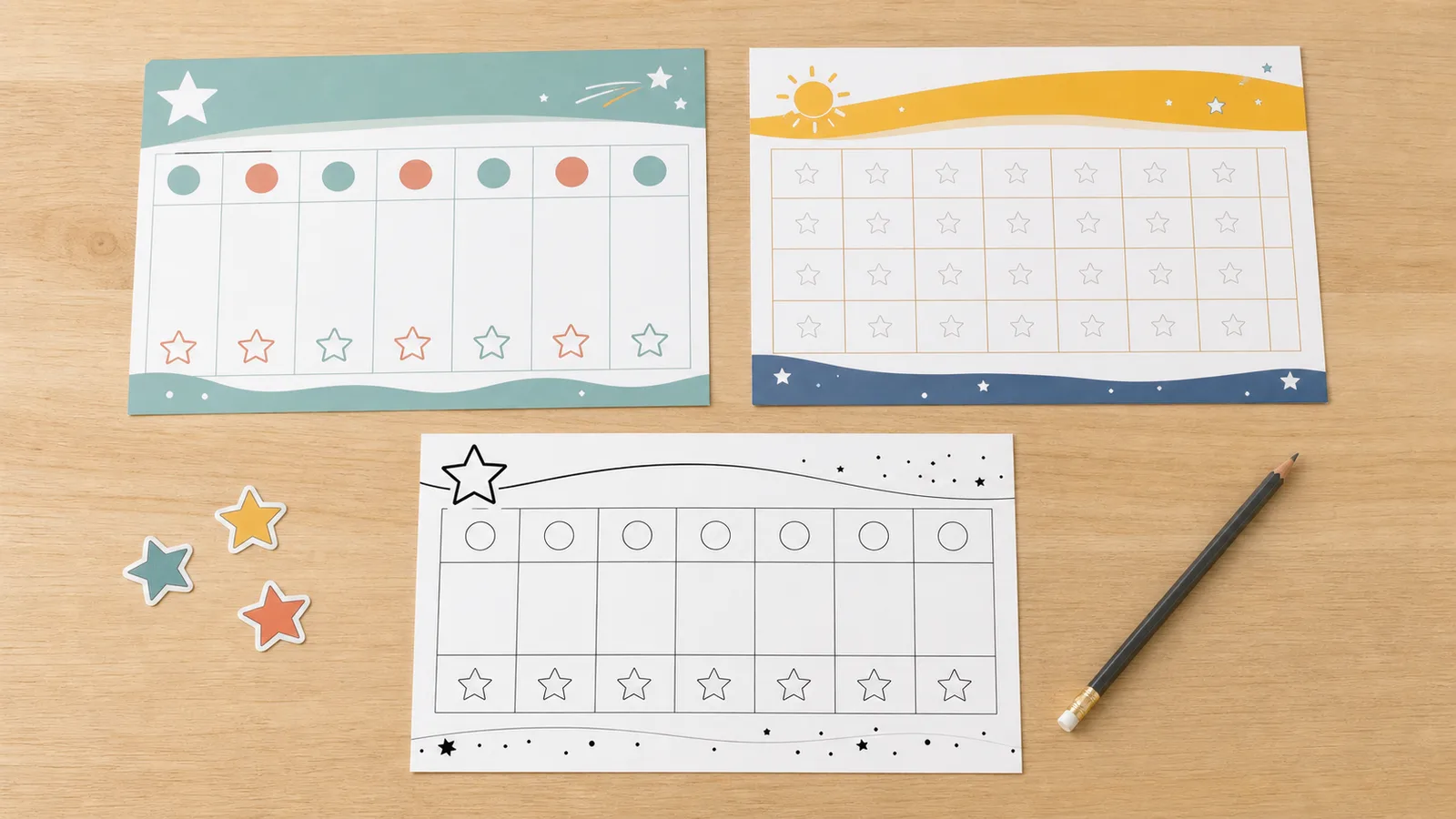
Every control changes the printable itself, with no account, child profile or prewritten reward plan.
Add a first name, initial or nickname to the chart. The value stays in your browser and is not saved.
Write specific positive behaviors, use a neutral suggestion or leave a row blank for handwriting after printing.
Choose a seven-day grid for quick feedback or a 31-space grid for longer progress.
Print outline stars to color or stamp, or use clean square cells sized for stickers, ticks and small drawings.
Use calm teal, sunny color or a black-and-white layout designed for economical home printing.
Download the live layout as a crisp vector PDF with no watermark, or print the chart directly.
Define one attainable action, mark it promptly and review whether the chart is still helping.
Enter ‘put pajamas in the hamper’ rather than ‘be good’. The chart works best when the action is observable, age-appropriate and already within the child's ability. Start with one to three rows and let the child help choose words they understand.
Choose weekly for immediate feedback or monthly for an older child who already understands the routine. Decide whether stars, stickers or check marks will fill the grid, then set a target that allows early success. Add the mark soon after the behavior and explain exactly what it recognizes.
A missed space simply stays empty. Do not remove marks already earned or compare siblings' totals.
A reward can be choosing a story, family game or shared activity; it does not need to be expensive or material. Print the chart at Actual size or 100%, keep it visible if the child is comfortable and review it together. When the action becomes routine, space out marks and retire the chart.
If the chart causes distress, arguments or shame, pause it and choose another support. A printable is not a substitute for individual professional advice.
Read the printing guideAnswers to searches about chart formats, ages, targets, rewards, printing and privacy.
Yes. The chart is free to personalize, print and download without a sign-up, subscription or watermark. Edit the name, title, positive goals, weekly or monthly period, target, reward, marker style, theme and paper size before exporting the PDF.
They describe closely related tools. A reward chart records progress toward an agreed recognition; a star chart uses star-shaped marks; a sticker chart leaves spaces for stickers. This reward chart printable supports outline stars and square sticker spaces, so choose the marking method your child can understand and enjoy.
Visual charts are often easiest for children around ages 3–8, but readiness matters more than a birthday. A younger child needs one simple behavior, immediate praise and a short target. An older child may prefer points or a private plan. Stop using the reward chart printable if it feels confusing, infantilizing or stressful.
Begin with one to three specific behaviors, even though the generator allows five rows. A short chart is easier to understand and lets you respond consistently. Add another target only after the first routine is clear; broad goals such as ‘behave’ should be rewritten as an observable action.
Choose a target the child can reach soon. Five stars may suit a first weekly chart, while an older child who already knows the routine might use a longer target. The right number depends on age, ability and how often the behavior occurs. If progress stalls, lower the target rather than turning it into a threat.
A weekly reward chart printable gives young children a shorter link between action and recognition. A monthly grid can suit older children or frequent behaviors when milestones are discussed along the way. The period should never make success feel remote; switch back to weekly if 31 spaces are too abstract.
Ask what the child values and choose something feasible: an extra story, selecting a family game, choosing music during dinner or one-to-one time. Praise and attention can be powerful too. Do not make food, affection, essential care, rest or access to basic needs conditional on filling a reward chart printable.
No. An earned mark should stay earned. Leave a space blank when the target behavior does not happen, stay neutral and offer another chance. Removing stars can make the reward chart printable feel punitive or unpredictable. Address unsafe behavior directly with appropriate boundaries rather than using the chart as a threat.
Separate charts are usually clearer because siblings may have different abilities, goals and preferred rewards. If you display two charts, avoid rankings or comparisons. Each child should work toward a personal, reachable target. The generator processes one name per reward chart printable, so create a separate PDF for each child.
Select A4 or US Letter, download the PDF and choose Actual size or 100% in the print dialog. Use the black-and-white theme to save ink. The landscape reward chart printable has vector lines and type, so stars, sticker spaces and 31-day labels stay sharp.
Yes. Place the reward chart printable in a dry-erase sleeve or laminate it, then test an erasable marker in a corner. Reusable physical stickers or magnets can also work with close supervision. Reset the chart together; never erase already-earned progress in the middle of an agreed period.
No. The child's name, goals and reward are rendered locally in your browser and are not uploaded or stored by the generator. You can use an initial or nickname instead. The downloaded reward chart printable remains on your device, where you control how it is saved, printed or shared.
Need another option in this reward chart?
Add one child's name and a few positive goals, choose stars or sticker spaces, then print a weekly or monthly chart your family can review together.
Free • No registration • A4 and US Letter • Names processed locally