Staff spacing from 1.4 to 4 mm
The four spaces of a staff are always equal, so one number sets the whole system. Engraved size for neat copying, large size for beginners learning where notes sit.
Blank Sheet Music Generator
Blank sheet music where the staves fit what you are writing. Choose how many systems go on the page and how far apart the staff lines sit, pick portrait or landscape on A4, A5 or Letter, and download manuscript paper that prints at true size.
Free, no sign-up, no watermark — vector PDF and PNG generated in your browser.
The preview is drawn to scale from the same geometry that goes into the PDF, so the staff size you see is the staff size you write on.
Every sheet is drawn as vector geometry inside your browser. Nothing is uploaded and nothing is stored. How to print at actual size (100%)
A fixed download gives you one staff size and one stave count. Composers, teachers and beginners all need different ones — so both are numbers you set here.
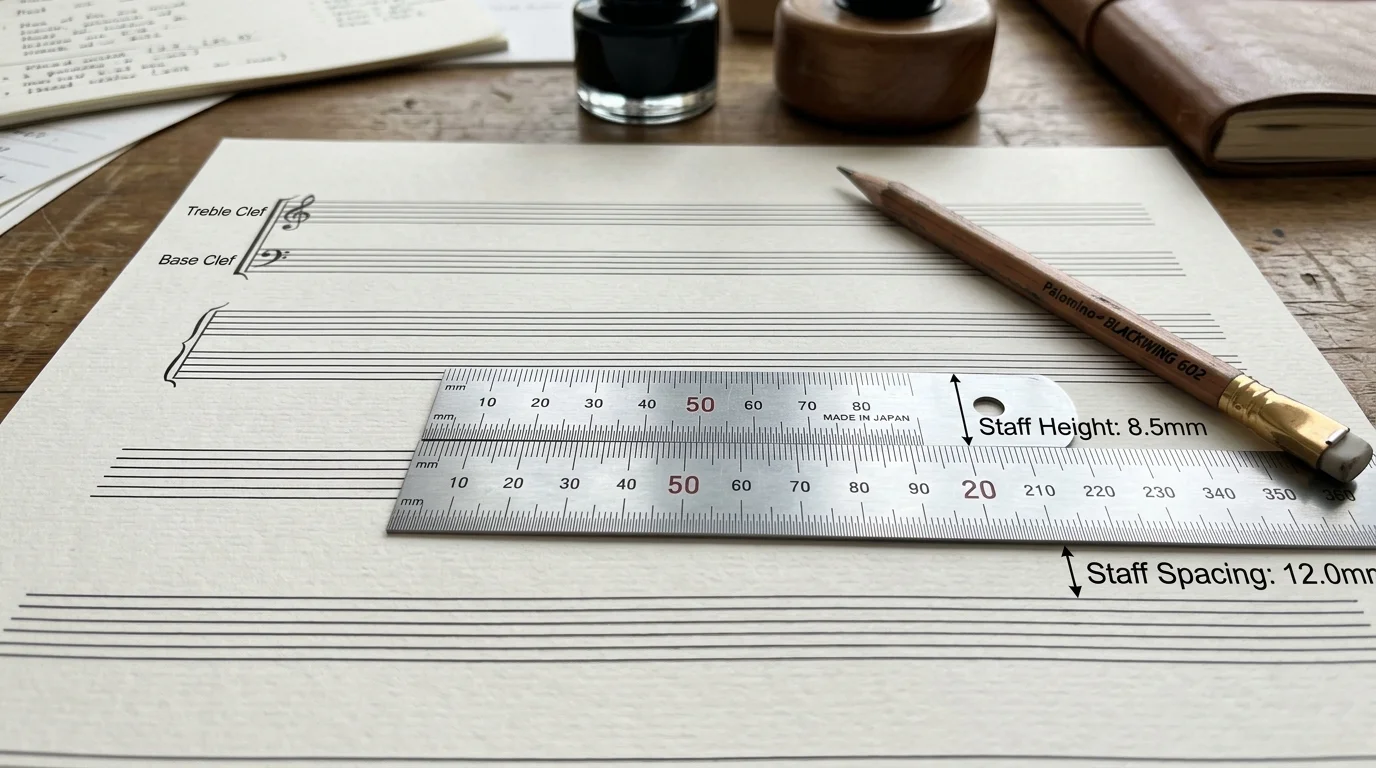
A staff is five lines and four equal spaces, and the height of one space decides how big a notehead has to be. Around 1.75 mm is engraved professional size, 2.4 mm suits comfortable handwriting, and 3.5 mm or more gives beginners room to place notes accurately. Set that one number and the whole system rebuilds — and because every sheet is written into the PDF as vector geometry at true PostScript points, a ruler on the print-out confirms it.
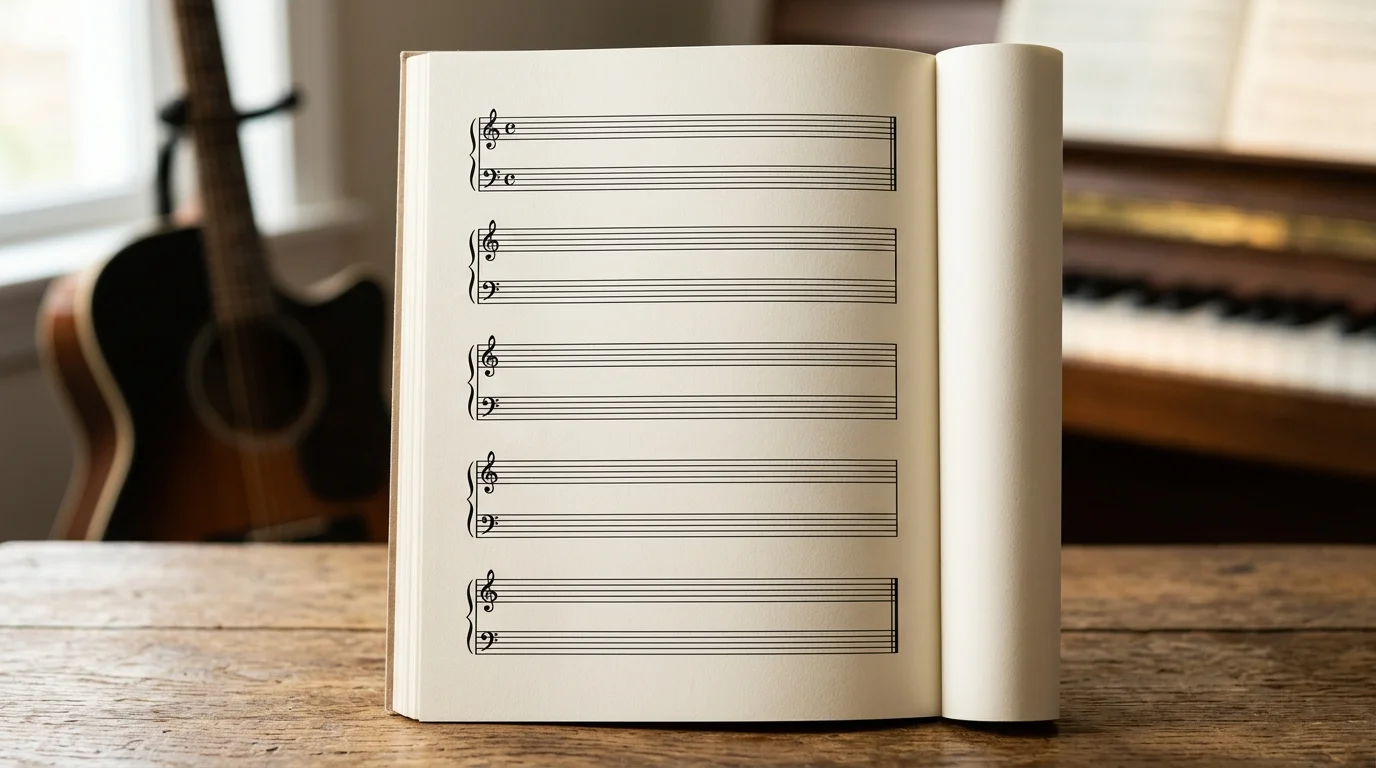
Ten staves is the usual single-line default, but a melody sketch wants fewer and larger, while a full page of exercises wants more and tighter. Set anything from four to sixteen and they are spaced evenly down the page with a bar line closing each end, so the sheet reads as manuscript paper rather than a set of stray horizontal rules.
Made for the desk of someone actually writing music, not for a template gallery.
The four spaces of a staff are always equal, so one number sets the whole system. Engraved size for neat copying, large size for beginners learning where notes sit.
Fewer and larger for sketching a melody, more and tighter for theory exercises and dictation. They are always spaced evenly, never crowded at the bottom.
Landscape gives each system more bars before it wraps, which is what you want for long phrases, lead sheets and anything you will read from a music stand.
Seven presets plus a colour picker. Pale grey staff lines let pencil noteheads dominate; black photocopies cleanly for a class set.
Put the piece name in the header and add a name-and-date rule so a folder of exercises stays sorted by student and by week.
Print-exact PDF, a PNG for tablet apps like forScore or Notability, and up to twenty identical pages in a single download.
Four steps from an empty page to manuscript paper you can write on.
Around 1.75 mm is engraved professional size, 2.4 mm is comfortable for handwriting, and 3 to 4 mm gives beginners and young students room to place noteheads accurately.
Ten is a sensible single-line default. Drop to six for a melody sketch with room for lyrics and chords, or raise it to fourteen for theory exercises and dictation drills.
Staves are distributed evenly, so the last system never ends up jammed against the footer.
Portrait A4 or Letter for general writing, landscape when each system needs more bars before it wraps, and A5 when the pages are going into a small notebook.
Lighten the staff lines so pencil noteheads and stems read clearly on top of them.
Export the PDF and choose Actual size or 100% scale in the print dialog rather than Fit to page, so the staff size you set survives the printer.
Read the printing guideStaff sizes, stave counts, clefs, paper sizes and printing.
Yes, completely. There is no account, no email wall, no watermark and no limit on how many sheets of manuscript paper you generate or print.
Published, engraved music sits around 1.75 mm between staff lines, which makes a staff about 7 mm tall. For handwriting, 2.2 to 2.6 mm is comfortable for most adults. Beginners and young children benefit from 3 to 4 mm, where a notehead is big enough to place on the right line without care.
Ten to twelve is standard for single-line instrument manuscript paper on A4 or Letter. Use six to eight when you want space to write lyrics, chord symbols or fingerings under each system, and fourteen or more for theory exercises where each answer is only a bar or two.
No — this is blank manuscript paper, so every staff is empty and you write your own clef, key and time signature. That keeps one sheet usable for treble, bass, alto and percussion work rather than committing the whole page to one clef.
Not as a linked pair yet. You can get very close by choosing an even number of staves and a slightly wider staff spacing, then bracketing each pair by hand — a common way musicians adapt single-line manuscript paper.
Yes. Switch the orientation to landscape and each system gains width, which fits more bars before the music wraps. Landscape is the usual choice for lead sheets and for anything read from a music stand.
Download the PDF instead of printing the web page, then set Scale to Actual size or 100% rather than Fit to page, and check the printer paper size matches your sheet. Measure a staff with a ruler: at 2.4 mm spacing the five lines should span 9.6 mm.
Yes. Download the PNG and import it as a page template in a note-taking or score-reading app such as GoodNotes, Notability or forScore, or import the PDF directly if the app accepts PDF templates.
Yes. Raise the page count before downloading and one PDF will contain up to twenty identical sheets, which is the quickest way to keep a supply of staff paper on the piano.
Yes — print and photocopy them freely for lessons, ensembles and your own writing. Reselling the generated PDFs, or bundling them into commercial printable products, is not permitted.
Something not working as expected?
Set the staff spacing and the number of systems, then print a stack.
No account, no watermark, and your manuscript paper never leaves your browser.
Free • Vector PDF & PNG • A4, Letter, A5 & Legal