Match the Beginning Sounds
Ages 4–5EasyAbout 5 min
Phonological awareness, letter knowledge and early word reading
Say each picture or letter aloud first. Ask the child to listen, match or order, then explain the choice in one short sentence.
Kindergarten Worksheets Printable PDF
Choose kindergarten worksheets printable PDF activities for early literacy, letter sounds, number sense, shapes, patterns, early math, cut-and-paste and fine motor practice. Filter by skill and difficulty, download one page, or combine a purposeful print pack.
Free, no sign-up and no watermark. Every page states the target skill, suggested age, estimated time and a brief teaching prompt.
This kindergarten worksheets printable PDF collection contains 42 original activities for ages 4–6. Start from the learning goal, then choose Easy, Growing or Challenge instead of relying on age alone.
42 kindergarten worksheets printable PDF pages
Each kindergarten worksheet shows a suggested age, difficulty, exact target skill, estimated time and short adult prompt. Select pages to build a balanced pack or download an individual PDF.
Phonological awareness, letter knowledge and early word reading
Say each picture or letter aloud first. Ask the child to listen, match or order, then explain the choice in one short sentence.
Phonological awareness, letter knowledge and early word reading
Say each picture or letter aloud first. Ask the child to listen, match or order, then explain the choice in one short sentence.
Phonological awareness, letter knowledge and early word reading
Say each picture or letter aloud first. Ask the child to listen, match or order, then explain the choice in one short sentence.
Phonological awareness, letter knowledge and early word reading
Say each picture or letter aloud first. Ask the child to listen, match or order, then explain the choice in one short sentence.
Phonological awareness, letter knowledge and early word reading
Say each picture or letter aloud first. Ask the child to listen, match or order, then explain the choice in one short sentence.
Phonological awareness, letter knowledge and early word reading
Say each picture or letter aloud first. Ask the child to listen, match or order, then explain the choice in one short sentence.
Phonological awareness, letter knowledge and early word reading
Say each picture or letter aloud first. Ask the child to listen, match or order, then explain the choice in one short sentence.
Phonological awareness, letter knowledge and early word reading
Say each picture or letter aloud first. Ask the child to listen, match or order, then explain the choice in one short sentence.
Counting, quantities, number order and part-whole thinking
Let the child count real objects first, then point to each printed dot once and connect the quantity to its numeral.
Counting, quantities, number order and part-whole thinking
Let the child count real objects first, then point to each printed dot once and connect the quantity to its numeral.
Counting, quantities, number order and part-whole thinking
Let the child count real objects first, then point to each printed dot once and connect the quantity to its numeral.
Counting, quantities, number order and part-whole thinking
Let the child count real objects first, then point to each printed dot once and connect the quantity to its numeral.
Counting, quantities, number order and part-whole thinking
Let the child count real objects first, then point to each printed dot once and connect the quantity to its numeral.
Counting, quantities, number order and part-whole thinking
Let the child count real objects first, then point to each printed dot once and connect the quantity to its numeral.
Counting, quantities, number order and part-whole thinking
Let the child count real objects first, then point to each printed dot once and connect the quantity to its numeral.
2D shape recognition, properties, composition and position
Name the shape, notice sides and corners, then find, compose or place it. Accept everyday shape words before adding formal terms.
2D shape recognition, properties, composition and position
Name the shape, notice sides and corners, then find, compose or place it. Accept everyday shape words before adding formal terms.
2D shape recognition, properties, composition and position
Name the shape, notice sides and corners, then find, compose or place it. Accept everyday shape words before adding formal terms.
2D shape recognition, properties, composition and position
Name the shape, notice sides and corners, then find, compose or place it. Accept everyday shape words before adding formal terms.
2D shape recognition, properties, composition and position
Name the shape, notice sides and corners, then find, compose or place it. Accept everyday shape words before adding formal terms.
Recognizing, extending and explaining repeating patterns
Read the pattern aloud together, cover the answer space and ask what repeats before the child draws or pastes the next item.
Recognizing, extending and explaining repeating patterns
Read the pattern aloud together, cover the answer space and ask what repeats before the child draws or pastes the next item.
Recognizing, extending and explaining repeating patterns
Read the pattern aloud together, cover the answer space and ask what repeats before the child draws or pastes the next item.
Recognizing, extending and explaining repeating patterns
Read the pattern aloud together, cover the answer space and ask what repeats before the child draws or pastes the next item.
Recognizing, extending and explaining repeating patterns
Read the pattern aloud together, cover the answer space and ask what repeats before the child draws or pastes the next item.
Picture addition, subtraction, comparison and simple reasoning
Tell the picture story with counters or fingers before writing. Ask how the child knows instead of checking only the final numeral.
Picture addition, subtraction, comparison and simple reasoning
Tell the picture story with counters or fingers before writing. Ask how the child knows instead of checking only the final numeral.
Picture addition, subtraction, comparison and simple reasoning
Tell the picture story with counters or fingers before writing. Ask how the child knows instead of checking only the final numeral.
Picture addition, subtraction, comparison and simple reasoning
Tell the picture story with counters or fingers before writing. Ask how the child knows instead of checking only the final numeral.
Picture addition, subtraction, comparison and simple reasoning
Tell the picture story with counters or fingers before writing. Ask how the child knows instead of checking only the final numeral.
Picture addition, subtraction, comparison and simple reasoning
Tell the picture story with counters or fingers before writing. Ask how the child knows instead of checking only the final numeral.
Picture addition, subtraction, comparison and simple reasoning
Tell the picture story with counters or fingers before writing. Ask how the child knows instead of checking only the final numeral.
Scissor control, sequencing and two-hand coordination
An adult demonstrates first. Use child-safe scissors, cut away from the helper hand, then sort, sequence or paste the pieces.
Scissor control, sequencing and two-hand coordination
An adult demonstrates first. Use child-safe scissors, cut away from the helper hand, then sort, sequence or paste the pieces.
Scissor control, sequencing and two-hand coordination
An adult demonstrates first. Use child-safe scissors, cut away from the helper hand, then sort, sequence or paste the pieces.
Scissor control, sequencing and two-hand coordination
An adult demonstrates first. Use child-safe scissors, cut away from the helper hand, then sort, sequence or paste the pieces.
Scissor control, sequencing and two-hand coordination
An adult demonstrates first. Use child-safe scissors, cut away from the helper hand, then sort, sequence or paste the pieces.
Pencil control, visual-motor integration and spatial accuracy
Trace once with a finger, then use a comfortable pencil grip. Stop when pressure, posture or accuracy noticeably declines.
Pencil control, visual-motor integration and spatial accuracy
Trace once with a finger, then use a comfortable pencil grip. Stop when pressure, posture or accuracy noticeably declines.
Pencil control, visual-motor integration and spatial accuracy
Trace once with a finger, then use a comfortable pencil grip. Stop when pressure, posture or accuracy noticeably declines.
Pencil control, visual-motor integration and spatial accuracy
Trace once with a finger, then use a comfortable pencil grip. Stop when pressure, posture or accuracy noticeably declines.
Pencil control, visual-motor integration and spatial accuracy
Trace once with a finger, then use a comfortable pencil grip. Stop when pressure, posture or accuracy noticeably declines.
Useful kindergarten printables begin with a clear learning target and leave room for children to think, talk and manipulate real objects.
Two five-year-olds can be ready for very different work. These kindergarten worksheets printable PDF pages separate early literacy, number sense, shapes, patterns, early math, cut-and-paste and fine motor goals. Each card names one target, difficulty, age band and estimated time, so families and teachers can combine a five-minute confidence page with a focused ten-minute challenge instead of printing an arbitrary thick workbook.
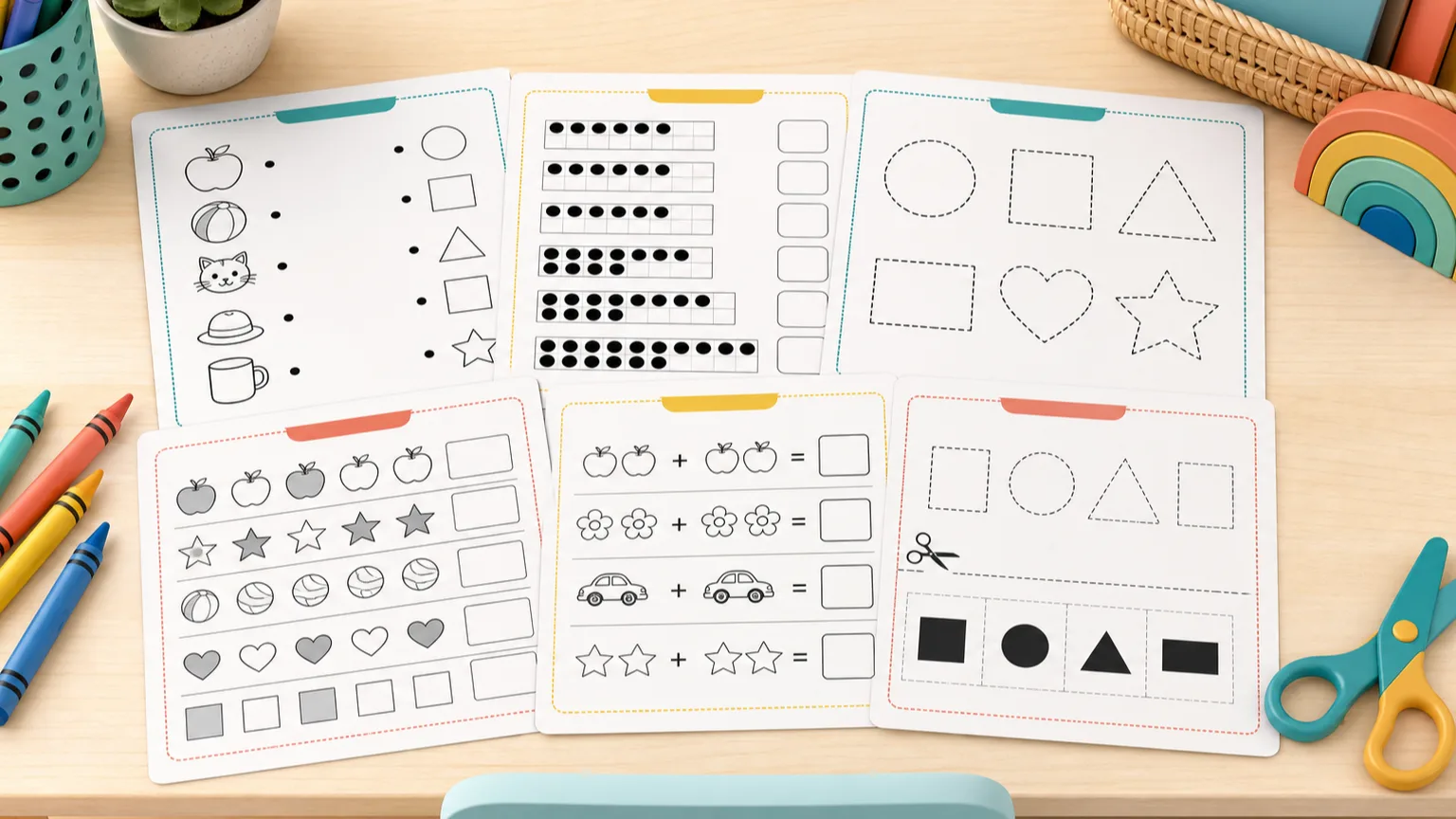
A kindergarten worksheet is most useful after a concrete experience: count buttons before marking dots, build a repeating pattern before drawing its next piece, or say picture names before matching sounds. Use the estimated time as a ceiling, not a demand. Sit nearby for the first example, ask the child to explain the choice, and stop before the pencil grip tightens. Kindergarten worksheets printable PDF practice should support stories, conversation, movement, blocks and outdoor play—not replace them.
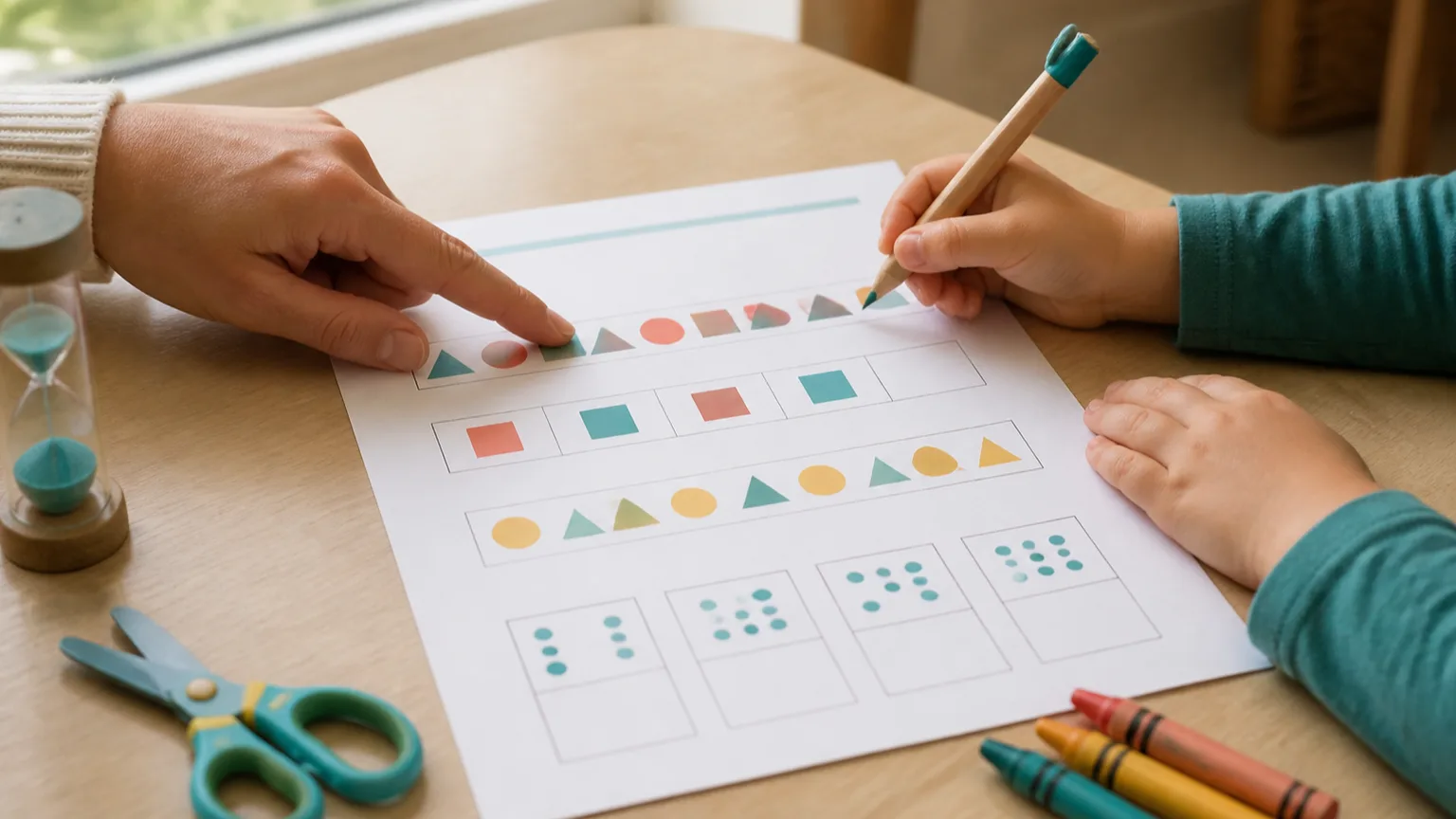
The library follows the related searches families and teachers use: phonics worksheets, number sense activities, shapes, patterns, kindergarten math and fine motor practice.
Beginning and ending sounds, rhyme, syllables, letter matching, CVC picture matches, word families and sentence order develop listening before independent reading.
Counting sets, ten frames, more and less, number order and number bonds connect written numerals to quantities and part-whole relationships.
Children name 2D shapes, compare sides and corners, find rotated examples, compose pictures and follow simple position words.
AB, AAB, ABB and ABC sequences progress from copying a visible repeat to finding a missing part and explaining the rule.
Picture stories introduce adding, taking away, making five or ten, comparison and simple data without reducing math to memorized marks.
Straight and curved cuts, sorting, sequencing, pencil paths, grids and mazes strengthen bilateral coordination and controlled movement.
Choose one observable goal, model the first item and use the finished page to decide what the child needs next.
Choose literacy, number sense, shapes, patterns, early math, cutting or fine motor practice. Then select Easy, Growing or Challenge. Kindergarten worksheets printable PDF filters make the progression visible without assuming every child of the same age needs the same page.
Every card states what the page practices and whether it is designed for about five, ten or fifteen minutes. Preview the adult prompt and prepare counters, crayons or scissors before inviting the child.
For literacy pages, say pictures aloud together. For number sense, use real objects before moving to printed dots and numerals.
See the skill mapChoose A4 or US Letter. Download one kindergarten worksheet printable PDF for today's goal, or select a few complementary pages and create one print-ready file.
A balanced pack might include one literacy page, one number or pattern page and one cut-and-paste or fine motor page—not every page in the library.
Print at Actual size or 100%. Demonstrate the first example, ask the child to explain, and note whether the task was accurate, effortful or frustrating. Reprint only when repetition still has a clear purpose.
Read the printing guideStraight answers to the questions parents, homeschoolers and kindergarten teachers commonly search before downloading worksheets.
Yes. All 42 original pages and the pack builder are free, with no account, email wall or watermark. Download one kindergarten worksheet printable PDF or combine selected pages into a single practice pack.
They are designed for children roughly ages four to six. The age on each card is a starting point, not a test. Use the named skill and difficulty to match what the child can currently do with light support.
The preschool collection focuses on readiness: broad pencil paths, basic shape recognition, letters, numbers 1–10 and first cutting. This kindergarten worksheets printable PDF library moves toward sound awareness, CVC words, number relationships to 20, pattern rules, picture operations and more precise visual-motor tasks.
Choose one Easy page tied to a skill you have observed. Try beginning sounds after shared picture naming, counting to 10 after counting objects, an AB pattern after building one with blocks, or controlled paths before grid copying.
Many children benefit from one focused five-to-ten-minute page. The cards show an estimated time, but stop earlier if posture, pencil pressure, attention or mood deteriorates. A short successful session is more useful than finishing every item.
Most pages use short visual tasks that an adult can check directly, so a separate answer key would add unnecessary printing. For open tasks such as composing shapes or explaining a pattern, more than one response may be reasonable; ask the child to explain the rule.
Some can after hearing the direction and watching one example. Early readers may need picture names or instructions read aloud, and cutting always needs close adult supervision. Independence means understanding the task, not being left without support.
Select the paper size before downloading, then print with Actual size or 100% enabled. Use portrait orientation and preview the margins. Black-and-white activity marks remain clear on a standard home or classroom printer.
Yes. You may print and photocopy the kindergarten worksheets printable PDF pages for your own children, pupils or homeschool group. Do not resell the files, upload them elsewhere or include them in a commercial printable bundle.
No. Printable pages can focus observation and practice, but children also need stories, conversation, songs, manipulatives, drawing, building, movement and play. Use each worksheet to extend a real experience, not as a complete curriculum.
Found a page that is unclear, inaccurate or difficult to print?
Filter 42 original pages by skill and difficulty, then select only the activities that match today's learning goal.
Download one page for a short session or combine a balanced kindergarten practice pack for the week.
Free • No sign-up • A4 and US Letter • No watermark