Straight-Line Pencil Trails
Ages 3–4Easy
Pencil control and left-to-right tracking
Start at the colored dot and follow each path slowly. Stop after one page if the hand tires.
Preschool Worksheets Printable PDF
Choose short, focused preschool worksheets printable PDF activities for pencil control, shapes, letters, numbers 1–10, matching, cutting, coloring and fine motor practice. Filter by skill and difficulty, download one page, or build a practice pack.
Free, no sign-up and no watermark. Every page states its age range, target skill and a simple adult instruction.
This preschool worksheets printable PDF collection starts with 36 carefully scoped pages. Each page gives one clear task, large marks for small hands and enough white space to keep the activity calm.
36 preschool worksheets printable PDF pages
Each card shows the suggested age, difficulty, target skill and a short activity tip. Select pages to build a practice pack, or download an individual PDF.
Pencil control and left-to-right tracking
Start at the colored dot and follow each path slowly. Stop after one page if the hand tires.
Pencil control and left-to-right tracking
Start at the colored dot and follow each path slowly. Stop after one page if the hand tires.
Pencil control and left-to-right tracking
Start at the colored dot and follow each path slowly. Stop after one page if the hand tires.
Pencil control and left-to-right tracking
Start at the colored dot and follow each path slowly. Stop after one page if the hand tires.
Pencil control and left-to-right tracking
Start at the colored dot and follow each path slowly. Stop after one page if the hand tires.
Pencil control and left-to-right tracking
Start at the colored dot and follow each path slowly. Stop after one page if the hand tires.
Shape recognition and controlled outlines
Name each shape, trace the dotted outline, then copy or find the same shape below.
Shape recognition and controlled outlines
Name each shape, trace the dotted outline, then copy or find the same shape below.
Shape recognition and controlled outlines
Name each shape, trace the dotted outline, then copy or find the same shape below.
Shape recognition and controlled outlines
Name each shape, trace the dotted outline, then copy or find the same shape below.
Shape recognition and controlled outlines
Name each shape, trace the dotted outline, then copy or find the same shape below.
Uppercase recognition and early letter formation
Say each letter, model the first stroke, then let the child trace before trying one independently.
Uppercase recognition and early letter formation
Say each letter, model the first stroke, then let the child trace before trying one independently.
Uppercase recognition and early letter formation
Say each letter, model the first stroke, then let the child trace before trying one independently.
Uppercase recognition and early letter formation
Say each letter, model the first stroke, then let the child trace before trying one independently.
Uppercase recognition and early letter formation
Say each letter, model the first stroke, then let the child trace before trying one independently.
Uppercase recognition and early letter formation
Say each letter, model the first stroke, then let the child trace before trying one independently.
Numeral recognition, counting and quantity matching
Say the numeral, count the dots aloud, and trace from top to bottom without rushing.
Numeral recognition, counting and quantity matching
Say the numeral, count the dots aloud, and trace from top to bottom without rushing.
Numeral recognition, counting and quantity matching
Say the numeral, count the dots aloud, and trace from top to bottom without rushing.
Numeral recognition, counting and quantity matching
Say the numeral, count the dots aloud, and trace from top to bottom without rushing.
Numeral recognition, counting and quantity matching
Say the numeral, count the dots aloud, and trace from top to bottom without rushing.
Numeral recognition, counting and quantity matching
Say the numeral, count the dots aloud, and trace from top to bottom without rushing.
Visual discrimination and one-to-one matching
Name the items on both sides, then draw one line between each matching pair.
Visual discrimination and one-to-one matching
Name the items on both sides, then draw one line between each matching pair.
Visual discrimination and one-to-one matching
Name the items on both sides, then draw one line between each matching pair.
Visual discrimination and one-to-one matching
Name the items on both sides, then draw one line between each matching pair.
Scissor control and two-hand coordination
An adult demonstrates first. Cut on the broken line with child-safe scissors, then sort or paste the pieces.
Scissor control and two-hand coordination
An adult demonstrates first. Cut on the broken line with child-safe scissors, then sort or paste the pieces.
Scissor control and two-hand coordination
An adult demonstrates first. Cut on the broken line with child-safe scissors, then sort or paste the pieces.
Scissor control and two-hand coordination
An adult demonstrates first. Cut on the broken line with child-safe scissors, then sort or paste the pieces.
Grip endurance and coloring within a boundary
Use a chunky crayon and color with short strokes; neatness matters less than comfortable control.
Grip endurance and coloring within a boundary
Use a chunky crayon and color with short strokes; neatness matters less than comfortable control.
Hand-eye coordination and precise movement
Follow the route without touching the edges. Repeat with a finger first if the pencil task feels hard.
Hand-eye coordination and precise movement
Follow the route without touching the edges. Repeat with a finger first if the pencil task feels hard.
Hand-eye coordination and precise movement
Follow the route without touching the edges. Repeat with a finger first if the pencil task feels hard.
A printable page works best as a brief invitation to move, notice and talk—not as a long block of desk work.
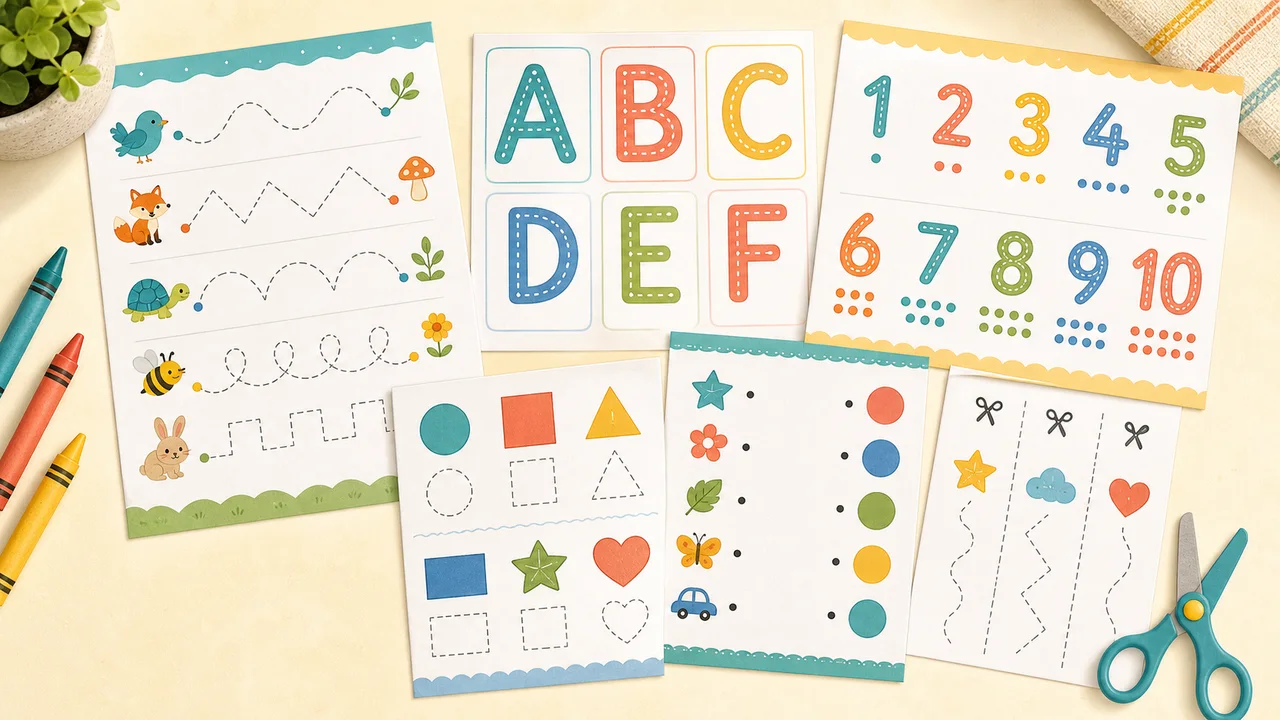
Dense activity books can make a three-year-old unsure where to begin. These preschool worksheets printable PDF pages isolate one target: a short tracing path, three numerals, one matching set or one cutting pattern. Large marks and open space reduce visual competition, while the age, skill and adult direction on every page make it easier to pick a sensible starting point.
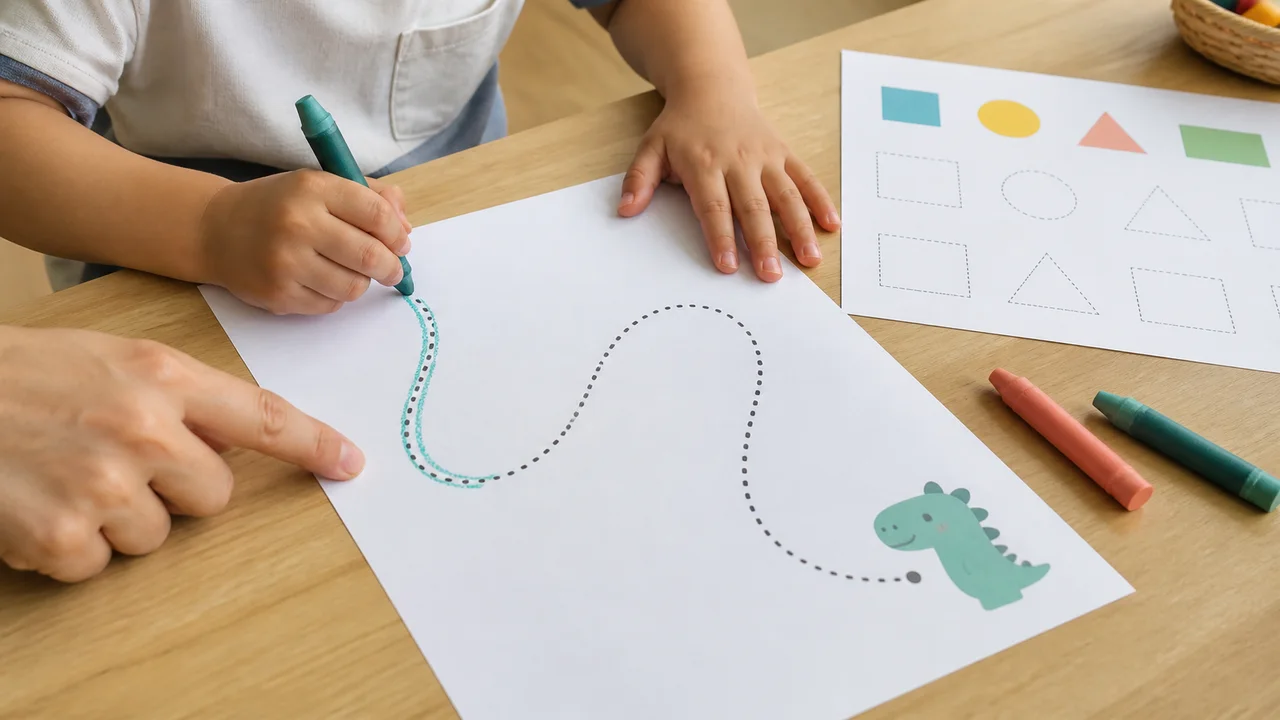
For most preschoolers, five to ten calm minutes is more useful than finishing a thick packet. Let the child trace with a finger first, offer a chunky crayon, and stop when grip or posture becomes tense. Preschool worksheets printable PDF activities should sit beside blocks, clay, drawing, stories and outdoor play; they are a focused practice tool, not a replacement for play-based learning.
The collection follows the searches parents and teachers actually make: tracing, early literacy, early math and fine motor practice.
Straight, curved, wavy, looped and zigzag paths progress toward circles, squares and triangles without jumping straight into small letterforms.
Large A–Z groups, vowel recognition and uppercase-to-lowercase matching keep early literacy tasks brief and visually clear.
Numeral tracing is paired with dots and ten frames so the written symbol stays connected to a quantity the child can count.
Same-shape, size, half-picture and shadow matching pages build careful looking before a child draws a one-to-one connection.
Wide straight paths come first, then curves, sorting and patterns. Always use child-safe scissors with close adult supervision.
Large coloring boundaries, dotted routes and simple mazes strengthen controlled movement without demanding tiny, tiring marks.
Pick the page for the child in front of you, then keep the session short and concrete.
Choose tracing, shapes, letters, numbers, matching, cutting, coloring or fine motor practice. Then use Easy, Growing or Challenge to narrow the preschool worksheets printable PDF library without guessing from age alone.
Every card tells you the suggested age, the exact skill and how an adult can introduce it. Age bands overlap on purpose: hand control develops at different speeds.
A child who avoids the pencil may be happier tracing with a finger or driving a toy car along the path first.
Use Download PDF for a single activity. Tick several cards and the pack button combines them into one print-ready PDF for A4 or US Letter.
A three-page pack—movement, number or letter, then coloring—is usually enough for several short sessions.
Choose Actual size or 100% in the print dialog. Model the first item, let the child try, praise effort and stop before the hand becomes tired.
Read the printing guidePractical answers based on the questions families and early-years teachers search most often.
Yes. All 36 pages and the pack builder are free, with no account, email wall or watermark. Download one preschool worksheet printable PDF or combine selected pages into a single practice pack.
They are designed for ages three to five, with overlapping age suggestions on every page. Readiness matters more than a birthday: begin when the child can copy a simple line and use a chunky crayon comfortably.
Keep it brief—often five to ten minutes or one page is enough. Stop sooner if grip, posture or mood becomes tense. Preschool worksheets printable PDF activities should complement drawing, clay, blocks, books, conversation and active play.
Start with Easy line tracing or large-shape coloring. Move to curves and shape outlines, then letters or numbers only when the child follows paths comfortably. The skill and difficulty filters make that progression visible.
There is no need to force one fixed order. Follow the child's interest and work from meaningful examples, such as the first letter of their name or counting three favorite objects. Pair symbol tracing with saying, finding and counting.
No. Tracing offers focused pencil-control practice, but hands also need varied play: clay, threading, blocks, tearing paper, painting and using tools. Treat preschool worksheets printable PDF pages as one small part of a broad play-based routine.
Use blunt-tip child-safe scissors at a table with close adult supervision. Demonstrate opening and closing the blades, keep the helper hand away from the cutting line and begin with the wide straight paths before curves.
Yes. Choose A4 or US Letter above before downloading. Print with Actual size or 100% selected rather than Fit to page so tracing paths, shapes and margins stay at their intended size.
Yes. Teachers, nurseries and families may print and photocopy the pages for their own children or pupils. You may not resell the PDFs, upload them elsewhere or package them as a commercial printable product.
Found a page that is unclear or difficult to print?
Filter the 36 original pages by skill and difficulty, then choose only the activities this child needs now.
Download one page for today or combine a small practice pack for the week.
Free • No sign-up • A4 and US Letter • No watermark