Single number or useful ranges
Target any number from 0 to 20, or build number tracing worksheets for 0–9, 1–10, or 1–20 in one click.
Number Tracing Worksheets
Make one focused page or a complete 0–9, 1–10, or 1–20 set with formation arrows and quantity models that give every numeral meaning.
Free printable PDF • No sign-up • No watermark • Generated privately in your browser
Choose a single number or a full range, then match tracing practice with ten frames, counting objects, or dot quantities.
Number to practise
A quantity model connects the written symbol to how many. For 11–20, ten frames show one full ten plus the extra ones.
Number 5
Your number tracing worksheets are rendered as a vector PDF in your browser; no worksheet data is uploaded. How to print at actual size (100%)
Writing a numeral and understanding its quantity are related skills. These number tracing worksheets put both on the same uncluttered page.
A large solid model gives the child a clear target while a green start dot and short arrow cue the first movement. Beside it, choose a ten frame, counting pictures, or organized dots. The child can say the number, count the quantity, finger-trace the model, and only then use a pencil. That sequence turns number tracing worksheets into a brief number-sense lesson instead of repetitive mark making.

Choose one number when a learner reverses or hesitates over a particular form. Choose 0–9, 1–10, or 1–20 when you need a sequenced booklet or class packet. Every page keeps the same number height, tracing style, quantity model, and number of blank rows, and the complete number tracing worksheets download as one crisp vector PDF rather than twenty separate files.
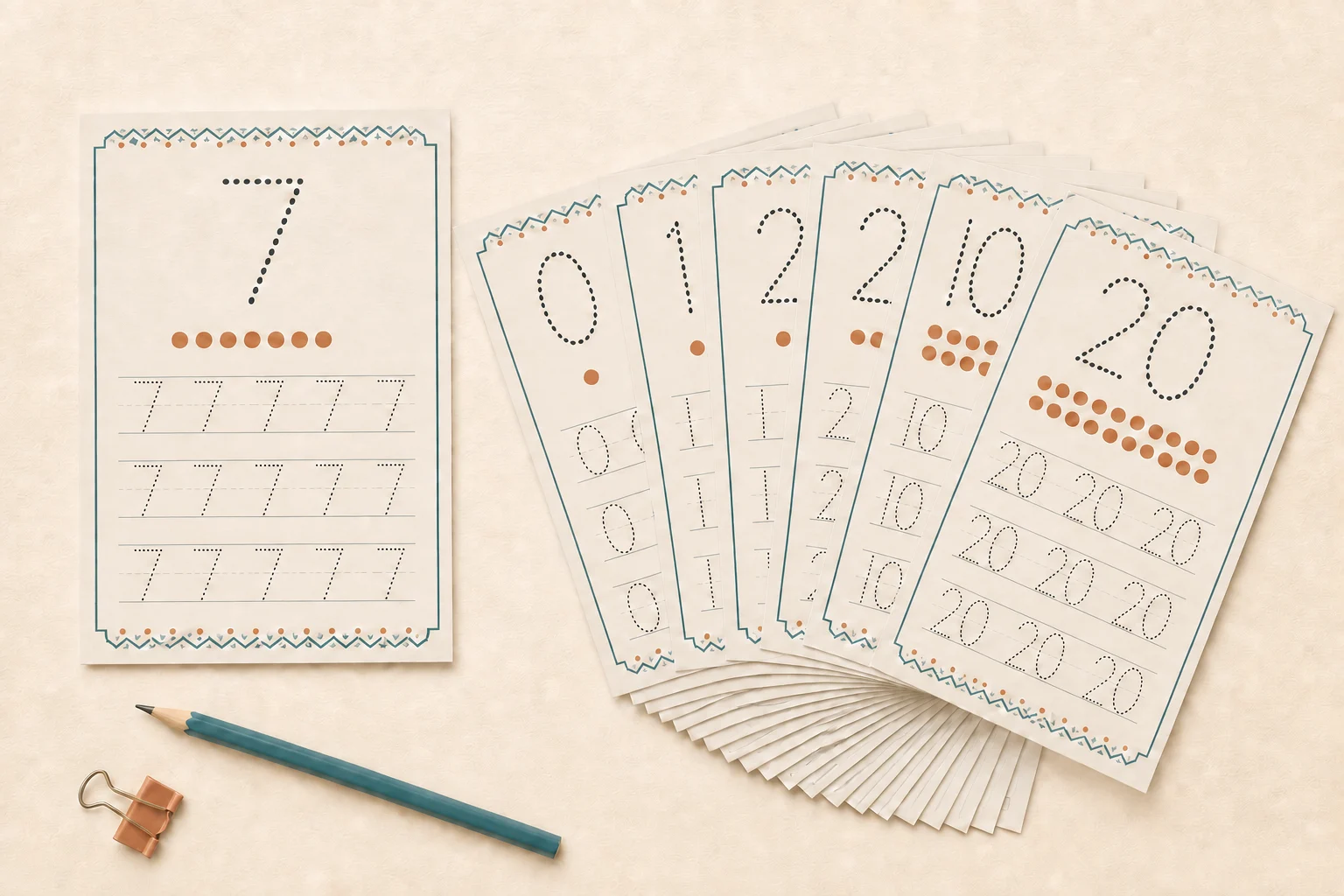
Keep the practice aligned with the learner’s current goal instead of printing the same fixed page for everyone.
Target any number from 0 to 20, or build number tracing worksheets for 0–9, 1–10, or 1–20 in one click.
Optional start dots and arrows show the first movement without covering the numeral in a crowded, hard-to-follow diagram.
A ten frame makes five and ten easy to see. Numbers 11–20 use two frames, showing one complete ten and the remaining ones.
Swap the ten frame for star pictures or organized dots when the lesson calls for counting objects and matching numeral to quantity.
Set dotted, outline, or light-grey tracing rows and add blank rows for independent writing on the same number tracing worksheets.
Choose A4 or US Letter. Curves and dots stay sharp, and number height is controlled in millimetres rather than vague small or large presets.
A short, attentive routine has more value than filling every row.
Select one number for focused correction, 0–9 to practise numeral forms, 1–10 for an early counting sequence, or 1–20 when the learner is ready to connect teen numbers to a full ten and extra ones.
Use ten frames for structured subitizing and the ten-plus relationship, pictures for one-to-one counting, or dots for a quieter visual. Turn quantity models off when the goal is formation only.
Ask “How many?” before the pencil touches the tracing row.
Point to the start dot, demonstrate the full movement, and let the child trace two or three careful examples. Add blank rows for an independent attempt; quality is more important than completing every repetition.
If grip, posture, or number shape worsens, stop and return later rather than finishing the page.
Choose A4 or US Letter to match the loaded paper, download the vector PDF, and select Actual size or 100% in the print dialog. Fit to page may shrink the number height and writing space.
Read the printing guidePractical answers to common searches about free PDFs, age, number order, ten frames, reversals, arrows, and printing.
Yes. Create one page or full 0–9, 1–10, and 1–20 number tracing worksheets, then download or print without an account, paywall, or watermark. The vector PDF is generated in your browser.
They are commonly used in preschool, pre-K, and kindergarten, but readiness matters more than age. Before formal number tracing worksheets, children benefit from drawing vertical lines, curves, circles, and simple shapes with a comfortable grip.
Begin with the range used by the child’s curriculum. The 0–9 set focuses on the ten numeral symbols; 1–10 pairs early counting with writing; 1–20 adds two-digit forms and the idea of one ten plus extra ones. There is no need to finish the largest set first.
A traced 7 is only a written symbol. A ten frame shows what seven means and how it relates to five and ten. For 11–20, two frames make the structure visible: one full group of ten plus the remaining ones.
They serve different goals. Pictures support one-to-one counting, organized dots reduce visual clutter, and ten frames emphasize five, ten, and teen-number structure. Choose the representation the learner is currently using rather than adding all three at once.
The large model uses a start dot and compact arrow for the first movement, not a numbered map of every stroke. Number forms and school conventions vary, so an adult should demonstrate the complete movement once before the child traces.
They can reinforce a consistent movement pattern, but occasional reversals are common in early writing. Model the number, use a verbal cue, practise briefly, and compare it with a quantity. Seek advice from the child’s teacher if reversals remain frequent beyond the expected classroom stage.
Two or three focused rows may be enough. Watch the movement rather than counting finished lines, then use one blank row to check whether the child can form the number without a model. Stop when grip, posture, or accuracy deteriorates.
Yes. Choose One number and select any value from 0 through 20. Use a complete range only when you need a booklet, lesson sequence, or class packet; all selected pages download together in one PDF.
Choose A4 or US Letter to match your paper, then select Actual size or 100% in the print dialog—not Fit to page. The PDF uses vector paths, so dotted and outline numbers remain crisp at the size you selected.
Something not working as expected?
Choose one number or a complete 0–20 set.
Add the right quantity model, formation cue, tracing rows, and independent writing space.
Free • A4 or Letter • No sign-up • No watermark